
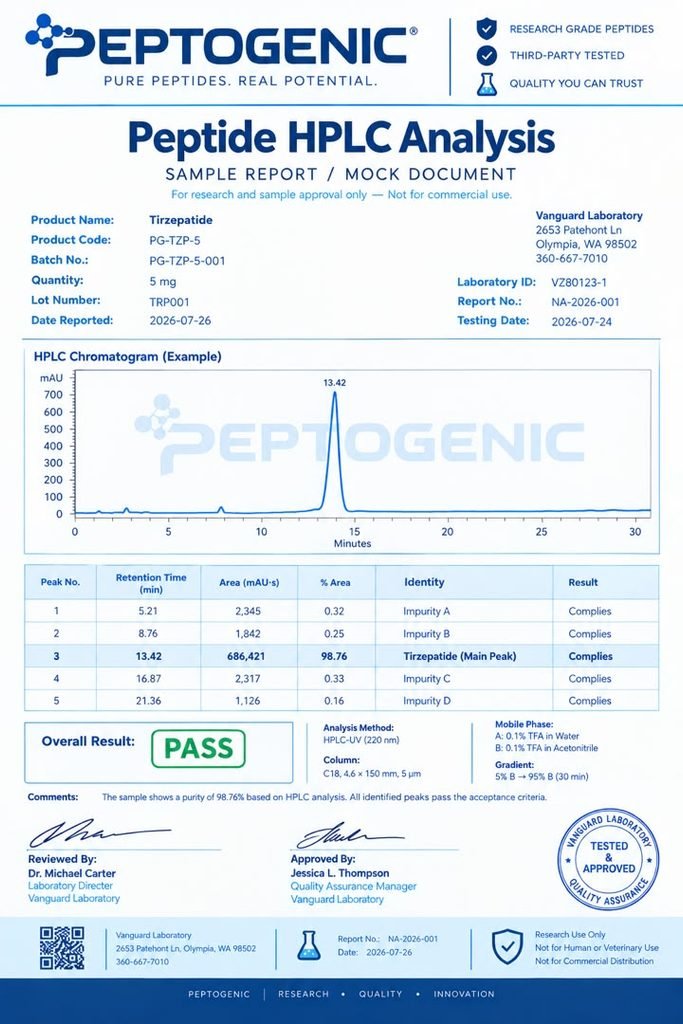
Peptide purity is an important consideration in laboratory research because the composition of a sample can influence how analytical results are interpreted. Researchers evaluating peptide materials may encounter terms such as purity percentage, high-performance liquid chromatography (HPLC), mass spectrometry and Certificate of Analysis (COA).
Although these terms are closely related, they do not mean the same thing. HPLC is an analytical technique, a COA is a document reporting specified test results, and a purity percentage describes a particular aspect of the material under defined analytical conditions.
Understanding these differences helps researchers assess laboratory documentation, interpret analytical results and recognise the limitations of individual tests.
This guide explains how peptide purity is reported, what a peptide COA may contain, how HPLC analysis works and which questions to consider when reviewing scientific documentation.
What Is Peptide Purity?
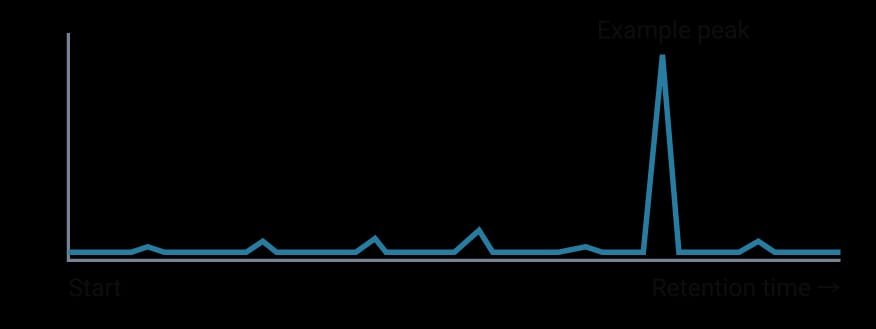
Peptide purity generally refers to the proportion of the detected material attributed to the intended peptide relative to other detected components, according to a specified analytical method and calculation.
In many analytical reports, peptide purity is estimated using chromatographic data. The result may be expressed as a percentage of the integrated signal associated with the principal peak relative to the total integrated signal from selected peaks.
However, the exact calculation depends on the method, detector, integration settings and reporting conventions used by the laboratory.
For example, a report might state that a sample has a chromatographic purity of 97%. This number should be interpreted according to the test method and the report’s definition of purity. It should not automatically be interpreted as meaning that 97% of the sample’s total mass consists of the intended peptide.
The distinction matters because chromatographic peak area and actual material content are not necessarily equivalent.
Different compounds may produce different detector responses, and some substances may not be detected adequately under the conditions used. Consequently, a purity percentage is most useful when the analytical method and its limitations are understood.
What Is a Peptide Certificate of Analysis (COA)?
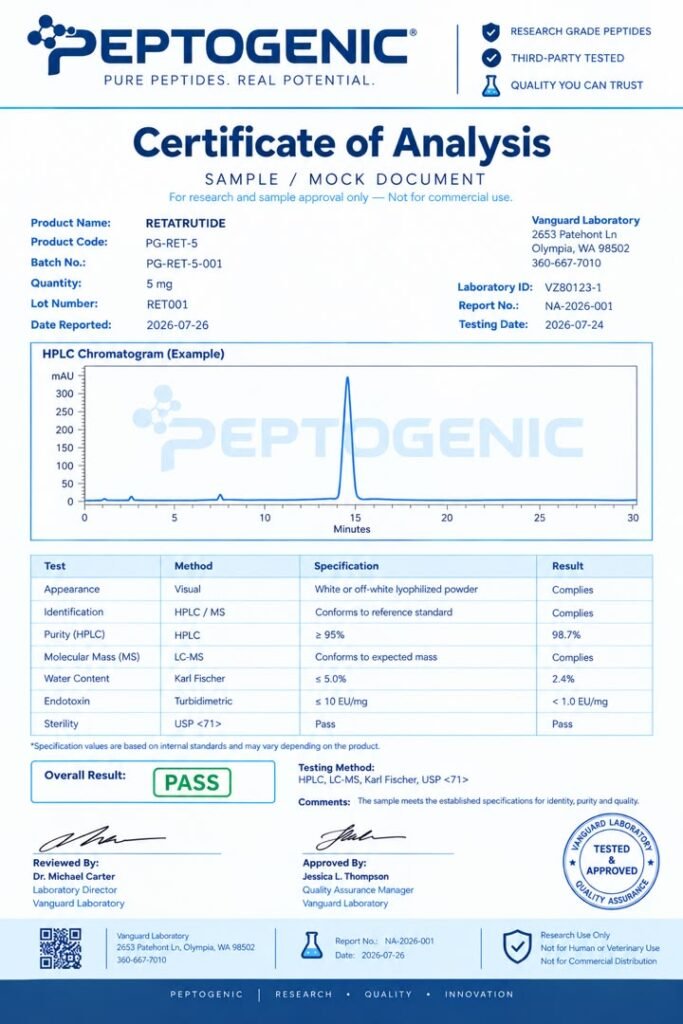
A Certificate of Analysis, commonly abbreviated as COA, is a document that records specified analytical test results for an identified material or batch.
In an appropriate laboratory or manufacturing context, a COA helps readers understand which material was tested, which tests were performed and how the reported results compare with stated specifications.
A COA may contain several types of information, including:
- Product or material name.
- Batch or lot identification.
- Laboratory or issuing organisation details.
- Date of analysis or report issuance.
- Analytical methods used.
- Test specifications or acceptance criteria.
- Reported results and units, where applicable.
- Relevant comments, qualifications or limitations.
The information included depends on the laboratory, the material, the intended purpose of the document and the applicable quality requirements.
A document labelled “COA” should not be treated as conclusive proof of every quality characteristic. Its value depends on the credibility of the issuing laboratory, the identity of the tested sample, the relevance of the methods and the completeness of the reported information.
For further context, the US Food and Drug Administration’s “guidance on good manufacturing practice for active pharmaceutical ingredients” (https://www.fda.gov/regulatory-information/search-fda-guidance-documents/q7a-good-manufacturing-practice-guidance-active-pharmaceutical-ingredients) discusses certificates of analysis and the information expected in that regulated manufacturing context.
What Is HPLC Peptide Analysis?
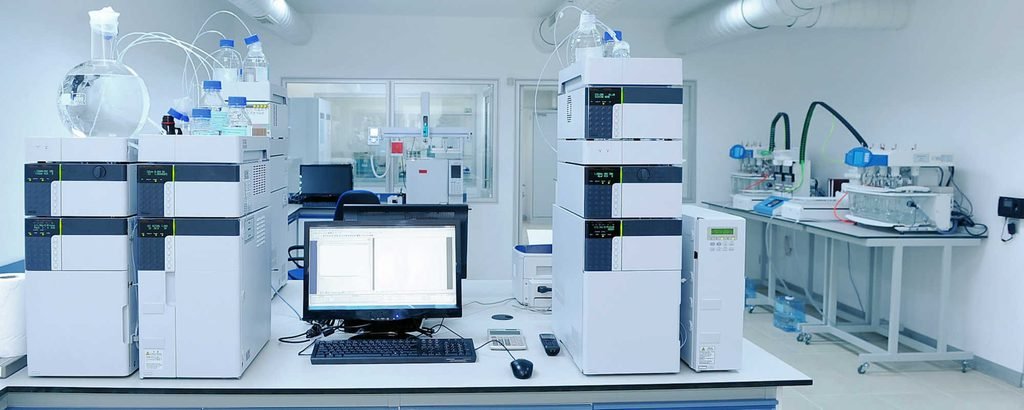
High-performance liquid chromatography, or HPLC, is an analytical separation technique used to separate components in a sample as they pass through a chromatographic column.
The components interact differently with the column and mobile phase, causing them to elute at different times. A detector records signals from the components it detects, producing a chromatogram.
Researchers can examine this chromatogram to investigate the separation profile of the sample and, where appropriate, estimate relative peak areas.
HPLC methods vary. The column chemistry, mobile phase, detection system, sample preparation and operating conditions can affect the resulting chromatogram.
For peptide analysis, a chromatographic method may help identify the principal component, reveal detectable impurities or compare a sample with an appropriate reference under defined conditions.
However, a chromatogram must be interpreted in context. A prominent principal peak alone does not establish every aspect of a sample’s identity, concentration, composition or suitability for a particular purpose.
The FDA’s “biotechnology inspection guidance” (https://www.fda.gov/inspections-compliance-enforcement-and-criminal-investigations/inspection-guides/biotechnology-inspection-guide-1191) provides background on HPLC as a technique for characterising biological materials, including peptides.
How Is Peptide Purity Calculated From HPLC Results?
A common approach is to integrate the chromatographic peaks and calculate the area attributed to a selected peak relative to the total area of selected peaks.
A simplified area-percentage calculation is:
Peak area percentage = (area of the selected peak ÷ total area of included peaks) × 100
This calculation is only an illustration of relative chromatographic peak area. It is not a universal formula for determining the true mass fraction of a peptide.
The interpretation depends on which peaks are included, the detector’s response to the different components, the method’s ability to separate them and the rules used for integration.
Several factors can influence the result:
Peak separation: Components that are not adequately separated may appear as overlapping peaks, complicating interpretation.
Detector response: Different compounds can produce different signal intensities for the same amount of material.
Integration settings: Baseline placement, peak boundaries and the treatment of small signals can influence reported areas.
Undetected components: Materials that do not produce a suitable signal under the method’s conditions may not be represented in the calculated percentage.
Method suitability: A method developed for one material or purpose may not provide the same information when applied to a different sample.
For these reasons, a chromatographic purity result should be read alongside the method description and other relevant analytical evidence.
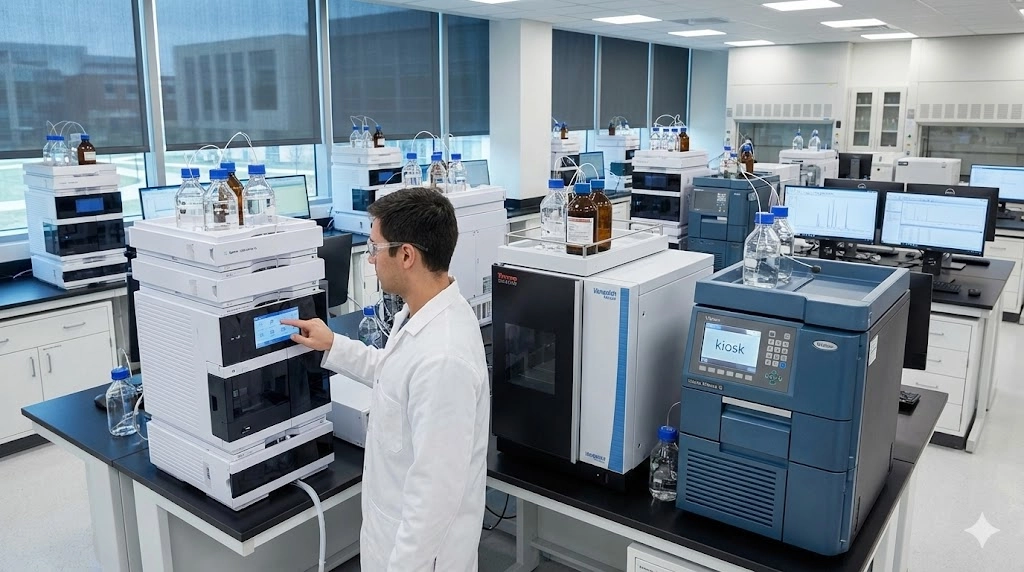
HPLC and mass spectrometry are different analytical techniques that can provide complementary information.
HPLC separates components according to their interactions with a chromatographic system. Depending on the method and detector, it can provide information about a sample’s separation profile and relative peak areas.
Mass spectrometry measures the mass-to-charge ratios of ions. Under appropriate conditions, the resulting data can help researchers investigate the molecular mass of detected species and support assessments of molecular identity.
When HPLC is coupled with mass spectrometry, often written as LC-MS, the separation and mass-related information can be obtained within a combined analytical workflow.
However, neither method automatically answers every question about a sample. The suitability of the evidence depends on the method, the expected material, the reference information and the question being investigated.
For example, a chromatographic peak and a mass consistent with the expected molecule may support an identity assessment, but the strength of that conclusion depends on the specificity and quality of the methods used. Additional analytical techniques may be appropriate when greater structural confirmation is needed.
The FDA’s guidance on “analytical procedures and method validation” (https://www.fda.gov/regulatory-information/search-fda-guidance-documents/analytical-procedures-and-methods-validation-drugs-and-biologics) explains the importance of suitable analytical methods for evaluating quality characteristics in regulated drug development.
What Should Researchers Check When Reading a Peptide COA?
A careful review begins with the document itself rather than the headline purity figure.
- Match the material and batch
Check the material name and batch or lot identifier. Where applicable, these details should correspond to the sample being evaluated.
A report that cannot be connected clearly to the relevant material provides limited evidence about that material.
- Identify the analytical method
Look for the test method used to obtain each result. A statement that a sample was “tested” is less informative than a report that identifies the method and explains the measured characteristic.
- Distinguish specifications from results
A specification describes a requirement or acceptance criterion. A test result describes what was observed or measured.
For example, a stated purity threshold is not necessarily the actual measured result. Check how the report presents these two pieces of information.
- Examine the supporting data
Where available, review the chromatogram, mass spectrum, method details or other supporting analytical information.
A single number may not provide enough context to evaluate the method’s performance or the conclusion drawn from the data.
- Check the issuing laboratory
Look for identifiable laboratory details, a report reference and a way to verify the document where such verification is available.
The appearance of a report or the presence of a laboratory logo alone does not establish authenticity or analytical quality.
- Understand what was not tested
A COA only supports conclusions relevant to the tests actually performed and the sample represented by the report.
For example, a chromatographic purity result does not automatically establish sterility, endotoxin levels, residual solvent levels, exact quantity, clinical safety or effectiveness in humans. Those questions require appropriate evidence and, where relevant, additional testing.
Does High Peptide Purity Guarantee Quality?
No. A high reported purity percentage is one piece of information, not a universal quality rating.
Quality assessments can involve multiple characteristics, including identity, content, impurities, physical properties and other tests appropriate to the material and its intended use.
The appropriate testing strategy depends on the material and the question being investigated. A method suitable for measuring relative chromatographic purity may not be sufficient to establish all other characteristics.
It is also important to distinguish analytical quality from biological activity. A purity result does not demonstrate that a compound produces a particular biological effect, nor does it establish safety or suitability for human use.
For scientific interpretation, conclusions should be proportionate to the available evidence and should not extend beyond what the methods can support.
Why Batch Traceability Matters
Analytical results are meaningful only when their relationship to the tested sample is clear.
Batch traceability connects a material to its identifying records and the associated analytical documentation. It can help laboratories determine which sample was tested and whether a report relates to the material under review.
Useful documentation may include consistent product and batch identifiers, report references, dates and relevant method information.
If a document relates to a different batch, a reference material or an unidentified sample, it should not automatically be treated as evidence about the material currently being assessed.
Traceability does not independently establish quality, but it is an important part of interpreting analytical documentation responsibly.
Frequently Asked Questions
What does 99% peptide purity mean?
It means the report has assigned a 99% purity value according to its stated method and calculation. If the value comes from HPLC peak-area analysis, it should not automatically be interpreted as 99% of the sample’s total mass being the intended peptide.
Is an HPLC chromatogram enough to confirm peptide identity?
Not necessarily. A chromatogram provides information about separation and detected signals. Identity assessment may require additional evidence, such as mass spectrometry or other suitable analytical methods.
What is the difference between a COA and a purity test?
A purity test is an analytical assessment. A COA is a document that reports specified results and other relevant information for a material or batch. A COA may include a purity result alongside other tests.
Does a COA prove that a peptide is safe?
No. A COA reports particular analytical findings. It does not automatically establish safety, clinical effectiveness, suitability for human consumption or regulatory approval.
Why can purity results differ between laboratories?
Differences in analytical methods, columns, detectors, sample preparation, reference materials, peak integration and reporting conventions can influence results. Comparisons are more meaningful when the methods and calculations are understood.
Conclusion
Peptide purity, COA documentation and HPLC analysis are closely related, but each serves a different purpose in laboratory research.
A purity percentage must be interpreted according to the analytical method and calculation used. HPLC can provide valuable separation data, while mass spectrometry and other methods may contribute additional information about molecular identity. A COA brings specified results and relevant documentation together for an identified material or batch.
The most responsible approach is to examine the sample identification, analytical methods, reported results and limitations rather than relying on a single headline percentage.
For researchers and readers evaluating peptide documentation, understanding what a test establishes—and what it does not establish—is essential to interpreting the available evidence accurately.
Explore more laboratory resources: Read our guides on [how to read a peptide Certificate of Analysis], [HPLC versus mass spectrometry] and [peptides and muscle research].
Educational information only. This article discusses analytical concepts and does not establish the safety, effectiveness or approval status of any research compound.