
Peptides and Muscle Research: Understanding Muscle Protein Synthesis
Peptides and muscle research are areas of scientific interest because skeletal muscle depends on complex biological processes to maintain its structure, repair tissue and adapt to physical activity. One of the most studied processes is muscle protein synthesis (MPS), the process through which cells produce new muscle proteins.
Understanding muscle protein synthesis helps researchers investigate muscle adaptation, protein turnover and the biological pathways involved in maintaining muscle tissue. However, it is important to distinguish established findings about muscle biology from experimental research involving individual peptides.

This guide explains muscle protein synthesis, the role of peptides in scientific research, the methods researchers use to study muscle growth, and the limitations of current evidence.
What Is Muscle Protein Synthesis?
Muscle protein synthesis is the biological process through which cells build proteins from amino acids. These proteins contribute to the structure and function of skeletal muscle tissue.
Muscle is continually undergoing protein synthesis and protein breakdown. The balance between these processes, alongside other biological influences, contributes to changes in muscle tissue over time.
When muscle protein synthesis exceeds muscle protein breakdown over a suitable period, the balance can support an increase in muscle protein content. When breakdown exceeds synthesis, muscle protein can be lost.
Researchers study these processes to better understand how skeletal muscle responds to exercise, nutrition, ageing, injury and different experimental interventions.
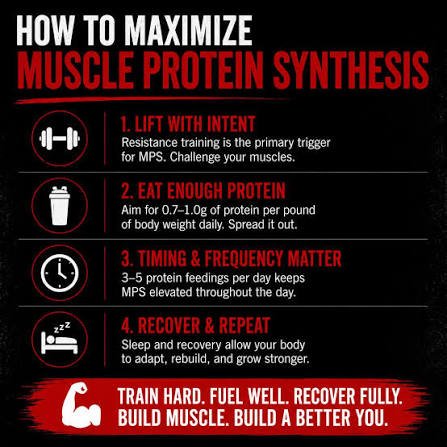
Muscle protein synthesis is not the only factor involved in muscle growth. Training history, mechanical loading, recovery, nutrition and other physiological processes can influence the overall response.
How Does Muscle Protein Synthesis Work?
Muscle protein synthesis involves several coordinated steps.
- Amino acids provide building blocks
Amino acids are used to construct proteins. The body obtains them through the breakdown and recycling of existing proteins and from dietary protein.
Researchers investigate how amino acid availability influences the body’s response to resistance exercise and other physiological conditions.
- Cells regulate protein production
Muscle cells use interconnected signalling pathways to regulate protein production. One important regulatory system involves mechanistic target of rapamycin complex 1 (mTORC1), which responds to various nutritional and cellular signals.
This pathway helps coordinate protein synthesis with the cell’s physiological state. However, the activity of one signalling pathway does not independently establish that a particular intervention will produce greater muscle mass.
- Exercise stimulates muscle adaptation
Resistance exercise can increase muscle protein synthesis. Research also shows that the size and timing of this response vary according to factors such as age, training conditions, nutritional status and the type of protein being measured.
A 2024 systematic review and exploratory meta-analysis examined controlled trials of muscle protein synthesis following resistance exercise. Its findings support the relationship between resistance exercise and measurable changes in muscle protein synthesis, while also highlighting variation between studies.
- Long-term adaptation involves multiple processes
A short-term increase in muscle protein synthesis does not automatically translate into a measurable increase in muscle size. Researchers must consider the duration of the intervention, protein breakdown, training exposure and longer-term changes in muscle tissue.

This distinction is important when interpreting scientific claims about muscle growth.
What Role Do Peptides Have in Muscle Research?
Peptides are molecules made up of amino acids connected by peptide bonds. They vary in length, structure and biological activity.
Researchers investigate different peptides to understand their interactions with biological systems, including signalling pathways, receptors and processes associated with tissue maintenance.
The phrase peptides and muscle research covers a broad scientific field rather than a single treatment or mechanism. Different peptides can have very different properties, and findings about one compound cannot automatically be applied to another.
Some research investigates peptides as potential biological signals, biomarkers or experimental tools. Other studies examine how specific molecules interact with pathways involved in muscle maintenance or muscle wasting.
The existence of a plausible biological mechanism, however, does not establish that a peptide increases muscle growth in humans.
To draw reliable conclusions, researchers need appropriate experimental evidence, well-designed studies and a clear understanding of the compound being investigated.
How Do Researchers Study Peptides and Muscle Growth?
Different research methods answer different scientific questions. Understanding these methods helps readers interpret research findings more accurately.
In vitro studies
In vitro studies examine biological processes outside a living organism, such as in cultured cells or laboratory systems.
Researchers may use these methods to investigate cellular responses, molecular interactions and potential mechanisms.
Although in vitro studies can help identify promising research questions, a response in cultured cells does not establish that the same effect will occur in a human body.
Animal studies
Animal studies can help researchers examine biological processes within a living organism. They may provide information about interactions between tissues and systems that cannot be fully assessed using isolated cells.
Nevertheless, animal findings do not necessarily translate to humans. Differences in biology, metabolism, dosing, study conditions and other variables can affect outcomes.
Human clinical studies
Human studies are necessary to establish how an intervention affects people under defined conditions. Their reliability depends on factors including study design, participant characteristics, sample size, comparison groups, duration and outcome measurements.
A well-designed human study can provide stronger evidence about a specific outcome than an isolated laboratory experiment. However, a single study may still have limitations and require confirmation.
Systematic reviews
Systematic reviews assess available studies using defined methods. They can help researchers identify consistent findings, disagreements and evidence gaps across a field.
The quality of a review depends partly on the quality and relevance of the studies it includes. A review of early laboratory experiments cannot, by itself, establish clinical effectiveness.
What Is the Difference Between Muscle Protein Synthesis and Muscle Growth?

Muscle protein synthesis is a biological process. Muscle growth is a broader outcome involving changes in muscle size and tissue composition over time.
This distinction matters because research frequently measures different outcomes.
For example, a study might measure changes in a signalling protein, the rate of muscle protein synthesis, muscle strength or muscle size. These outcomes are related in some contexts, but they are not interchangeable.
An intervention that changes a molecular marker has not necessarily demonstrated an increase in muscle mass. Similarly, a short-term change in protein synthesis does not automatically predict long-term strength or physical performance.
When reviewing a study, readers should identify exactly what the researchers measured and avoid treating preliminary biological findings as proof of a practical benefit.
What Should You Look for When Evaluating Peptide Research?
A careful review of the scientific evidence should consider several questions.
What compound was investigated?
Confirm the precise identity of the peptide. Findings about one molecule should not be generalised to every peptide or to a group of compounds with different structures and properties.
What type of study was performed?
Determine whether the research involved isolated cells, animals or human participants. The study type influences what conclusions can reasonably be drawn.
What outcomes were measured?
Look for the difference between laboratory markers and meaningful outcomes such as changes in muscle size or function. Also check whether the reported outcome was a primary or secondary measure.
How strong was the study design?
Consider the number of participants or experimental samples, the comparison group, the duration, the methods used and the limitations acknowledged by the authors.
Have other studies reproduced the findings?
Independent replication and consistent results across appropriately designed studies can increase confidence in a finding. One positive experiment is rarely sufficient to settle a complex scientific question.
Were the findings interpreted cautiously?
Reliable scientific reporting distinguishes observations from hypotheses and acknowledges uncertainty. Be cautious when marketing claims go beyond the outcomes actually measured in the research.
Can Research Peptides Be Assumed to Improve Muscle Growth?
No. The general category of peptides is too broad to support that conclusion.
A scientific rationale, an effect in a laboratory model or a change in a biological marker does not establish that a specific peptide safely and effectively increases muscle mass in humans.
The evidence must be assessed separately for each compound and each claimed outcome. Researchers should consider the quality of available studies, relevant human evidence, potential risks and applicable regulatory status.
Products described as being for laboratory research should not be assumed to be approved or suitable for human consumption. Research documentation also does not, on its own, demonstrate clinical safety or effectiveness.
Anyone considering a substance for health or performance purposes should seek advice from a qualified healthcare professional rather than relying on marketing statements or preliminary research.
Why Accurate Laboratory Documentation Matters
Scientific interpretation depends on knowing what material was investigated and how the reported results were obtained.
Laboratory documentation may include compound identification, batch information, analytical methods and reported test results. These details can help readers understand the scope of the available evidence.
A certificate of analysis (COA), for example, should be interpreted according to the specific tests performed and the limitations of the report. A reported purity result does not automatically establish every aspect of identity, safety, suitability or biological activity.
Researchers should also consider whether the documentation clearly identifies the tested sample and whether the reported findings are relevant to the question being investigated.
Transparent documentation supports informed interpretation, but it should never be presented as a substitute for appropriate scientific evidence.
Conclusion
Peptides and muscle research involve a broad range of scientific questions, from molecular signalling to muscle protein synthesis and the long-term maintenance of skeletal muscle.
Muscle protein synthesis is an important part of muscle biology, but it is only one component of a complex process. Understanding the evidence requires careful attention to study design, the type of outcome measured and the distinction between laboratory findings and demonstrated effects in humans.
For researchers, students and readers interested in peptide science, the most reliable approach is to examine individual compounds and studies critically, consult credible scientific sources and avoid conclusions that go beyond the available evidence.
Explore more: Read our related educational guides on [how to read a Certificate of Analysis (COA)], [HPLC versus mass spectrometry] and [understanding laboratory test results].
Educational information only. This article is not medical advice and does not establish the safety, effectiveness or approval status of any research compound.